Greetings from 'The King of Castle Rock'

Welcome to a special world, centered around the small town of Castle Rock. A place hidden in the darkness of evil. This world is filled with colorful characters and touching stories of hope and survival. Their homes spread across the land to places like Derry, Jerusalem's Lot, and worlds beyond our ability to imagine, waiting for us to explore them. All of this vast empire is ruled by one man, its creator, Stephen King. This blog is about the work of the undisputed 'Master of Horror', from the literature to the process. Enjoy your journey through the world that Stephen King built, and rules!


Showing posts with label IT. Show all posts

Thursday, May 17, 2012

Ka-tet: The Heart of King's World


Avid King readers have encountered the terms “Ka” and “Tet” in many of his works.  Even occasional readers may have seen these terms in some of his works.  However, this concept of “Ka” and “Tet” has deep roots in many King stories.  In order to help all King fans, even just the movie watchers, understand this concept, this article will explain its meaning and how to find it in King works.

What is a Ka-tet?

These terms are defined in The Dark Tower III: The Waste Lands as Roland tries to explain the purpose of the quest to Eddie and Susannah Dean, better known as “The Prisoner” and “The Lady of the Shadows” (61). 

  •          Ka is defined as “destiny.” However, Roland states that it is “much more complex in High Speech.”
  •          Tet is defined as “a group of people with the same interests and goals.”
  •          Roland identifies Ka-tet as “the place where many lives are joined by fate.”.


The Complete Stephen King Universe states, “ka-tet means a great many things, one of which is family” (16).  It continues to explain the group of people are “usually without blood relationships” and are bound together by “duty, obligation, love, and common objectives” (17).  It is important to note that enemies can also be a part of a ka-tet as their destiny is to “destroy each other” (17).

Examples of Ka-tets in King’s work

The most memorable Ka-tet in a King work is the one in the Dark Tower series.  Roland, the last gunslinger, leads his Ka-tet in pursuit of the “man in black” and in their journey to the Dark Tower itself.  Some members of Roland’s Ka-tet are Eddie Dean aka The Prisoner, Susannah Dean aka The Lady in the Shadows and Jake Chambers aka the boy at the Way Station or ‘Bama.  (These references are from the first three books in the Dark Tower series.)

However, the Dark Tower series is not the only King works that contain this unique dynamic of a group with the same destiny.  Stephen King’s IT (1986) contains a very strong Ka-tet.  The Loser’s Club, which is composed of the seven friends that battle the evil entity living in the sewers of Derry, is a Ka-tet that lasted for over thirty years. Another Ka-tet in this story is the two opposing forces, the Loser’s Club versus the evil entity.

The final story that I will discuss in relation to the concept of a Ka-tet is The Stand (1978).  This novel contains a complex structure of the Ka-tet concept.  The first Ka-tet is the group that is drawn to Mother Abigail Freemantle.  This group consisted of Stu Redman, Glen Bateman, Frannie Goldsmith, Nick Andros and the rest of the gang that created the “Free Boulder” zone.  The second Ka-tet is the group that was drawn by the Walking Dude, also known as Randall Flagg, to Las Vegas.  This group consisted of Lloyd Henreid, Trashcan Man, Barry Dorgan and the others who considered their leader to be Flagg.  The third Ka-tet is the enemy dynamic that forces the people of the “Free Boulder” zone against Randall Flagg and, by association, the people of the new Las Vegas.

I would argue that other Ka-tets exist within this story as well.  The Campion family could be a considered a Ka-tet.  Their family group left the base with a goal of escaping the virus that had been released.  Ultimately, they were the reason that the Captain Trip’s virus spread across America. Another Ka-tet could be identified as the military itself.  The various divisions of this particular group include “Project Blue” personnel, the group working to create the virus, and the military personnel, the ones who tried to contain it after the virus escaped and anarchy started to break out across America.

It is impossible to write about every example of a Ka-tet without composing an entire book on the subject.  However, being able to identify King’s use of Ka-tet in his work will help the reader, including you, see how he interweaves these characters as people and as those pursuing a similar destiny.  I can just about guarantee that you will look beyond the story to identify the Ka-tet in the next King work that you read. Happy reading, King’s “Constant Readers!”

Tuesday, April 10, 2012

'Life Between Frames' Article


The producers of the 'Life Between Frames' site have visited The King of Castle Rock and have given high praise of it. They asked me to write a film appreciation article on one of Stephen King's works. I chose one of my all-time favorites - the 1990 television miniseries adaptation of "IT." 

To see the article that I contributed to their site, follow the link provided here: Pennywise: Haunting Viewers Since 1990

Thanks to Jay Burleson and all those great people at Life Between Frames.

Sunday, April 8, 2012

Derry: A Town of Unspeakable Evil, Part 2

Derry, Maine: A Town of Unspeakable Evil
Part 2 – 1958 to 1998

In the first installment of this profile of Derry, I discussed the town, its history, and a few of its famous residents. Now I will discuss events that have been documented in King’s stories. Derry plays a significant role in the world that King has built. Due to the number of stories that take place in Derry, this will be a three-part series.


One event that must be discussed covers a time span from 1958 to 1985.  In 1958, children in Derry were disappearing or being killed at an alarming rate.  One of these victims was Georgie Denbrough who was killed while playing with a paper boat that his brother Bill made for him. Bill Denbrough and six of his friends created a club called “the Losers Club” while playing in the Barrens where they spent their childhood afternoons building a dam in the creek that flows through it.  The boys become convinced, due to things that they saw and experienced, that an evil murderer was stalking their hometown.  In 1958, they track the “murderer” into the sewers to exact revenge and stop the murders.  They believed that they were the only ones who could stop the murderer.


The Losers Club

In 1985, children started to disappear and be murdered again; This was also the same year of the Great Flood in Derry, which did damaged the city extensively and cost millions to repair. Mike Hanlon, the city librarian and a member of the Losers Club, contacted all of his childhood friends about the recent activity. They had made a promise as children to return if the murders started again.  Six of the seven members returned to Derry and faced the child-killing monster again.  In the course of their stay in Derry, Mike Hanlon was stabbed and one of their friends was killed. (For more about these events, see IT, 1986)

IT was inspired by the classic Norwegian fairy tale “The Three Billy Goats Gruff,” according to The Complete Stephen King Universe.

In 1994, Derry resident Ralph Roberts begins a descent into a type of madness created by insomnia and the loss of his first wife, Carolyn.  Ralph, who is a senior citizen, begins to see strange people-like beings that he calls “the little bald doctors.”  Ralph develops a sixth sense that allows him to see the auras of people around him.  One of the hardest things about Ralph’s newly developed abilities is the way that he can see death hanging over someone’s head.  Ralph described it as being able to see a “black balloon” over their heads.  This is not a pleasant gift to have in the town of Derry because death is a daily occurrence.

Ralph Roberts also develops the ability to know evil when he sees it.  Ralph decides that he must take action when he learns that his neighbor, Ed Deepneau, is planning an assault on the Derry Civic Center where Susan Day, a pro-choice activist, is speaking.  A mysterious force known as the Crimson King is manipulating Deepneau’s thoughts and wants the man to kill a child named Patrick Danville, who has an important place in history.  (To read about Ralph Robert’s life, see Insomnia, 1994).

To promote the release of Insomnia, Stephen King made a ten-stop tour of independent bookstores across the United States on his Harley-Davidson motorcycle. This trip helped inspire two novels, Desperation and The Regulators, which were released in 1996.

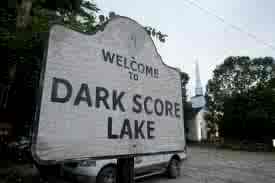
In 1998, Mike Noonan, a best-selling novelist who calls Derry home, finds his life changed in a significant way.  Noonan’s wife, Jo, dies from an aneurysm that occurs when she is expecting their first child.  Noonan becomes emotionally distraught and finds it difficult to pen another story.  He decides to leave Derry for a while and stay at their summer home at Dark Score Lake.  The home is called “Sara Laughs.”  The author believes that the writer’s block may be broken by staying at his summer home.


Mike Noonan (portrayed by Pierce Brosnan)

While staying near Dark Score Lake, Noonan becomes involved in a couple of different events.  He rescues a child from the street and then finds himself in the middle of a custody battle between the child’s mother, Mattie Devore, and her father-in-law, millionaire Max Devore. Noonan also begins receiving messages in various ways from spirits, one of which he believes to be his deceased wife. He also starts to investigate the possibility that his wife had an affair prior to her death.  The truth was much darker.  His wife had been investigating the rape and murder of a Jazz singer named Sara Tidwell that occurred nearly a century earlier. (Mike Noonan’s story can be found in Stephen King’s Bag of Bones, 1998)

Bag of Bones was adapted for television in 2011 and aired on A&E.  Stephen King read the audio version of this novel.

To Be Continued...


Sunday, March 25, 2012

Derry, Maine: A Town of Unspeakable Evil (Part 1)

Derry, Maine: A Town of Unspeakable Evil
Part 1 – Intro and History

In Stephen King’s world, evil lurks in the darkness, balanced with a sliver of good that prevents it from engulfing everything in its path.  However, Derry is a different kind of town, a place where evil is so entrenched that most of the residents are not even aware of its presence.  Derry looks like every typical American town with average citizens and a Norman Rockwell picturesque setting.  It could be Anywhere, USA; but it is not! 

Derry has a town square where the courthouse and surrounding shops compose the community’s center of activity and life.  Popular local stores provide all the necessary commodities of life and the gossip that small American towns seem to use as fuel for life.  Mr. Norbert Keene’s drugstore located near the square is the place where most residents of Derry fill their prescriptions and doctor their ailments.  The Derry Public Library is close to the center of town and is an important setting in the events that occur in the little town.

Outside of the square, Derry has several famous landmarks that everyone in town knows, and some that they go out of their way to avoid.  Kitchener Iron Works is part of the town’s history and an important business for Derry residents as well as Stephen King’s stories.  On the outskirts of town is the infamous place known as “The Barrens,” which is where the runoff water from the town streets eventually flows.  “The Standpipe” is located in Derry Memorial Park, which is “within a shout” of the Barrens, as described by Mike Hanlon in his unpublished book, Derry: An Unauthorized Town History (IT, page 149).  Derry also has a tall statue of Paul Bunyan and Babe, the Big Blue Ox, which are fictional characters from American folklore. One of the most recent landmarks in Derry is a statue dedicated to the memory of the “lost children” of the town (Dreamcatcher).  

Derry has a tragic and dark history that is reflective upon the evil that lives in the small New England town.  This history is the focus of Mike Hanlon’s book that is mentioned in the previous paragraph.  Here are some of the events that Hanlon retells in his book:

          1741 – The entire population of Derry township vanishes. Hanlon
          compares it to the Roanoke Island, Virginia colony, where all of
          the colonists disappeared in the early settlement of North America.

1851 – John Markson kills his entire family with poison, then consumes a deadly “white nightshade” mushroom.

1879 – A crew of lumberjacks find the remains of another crew that spent the winter snowed in at a camp in the upper Kenduskeag, at the tip of the modern-day barrens. All nine had been hacked to pieces.

1906 – On Easter Sunday, the Kitchener Ironworks explodes during an Easter egg hunt, resulting in 102 deaths.

1930 – The Black Spot, a Negro social club, is burned to the ground by the Maine Legion of Decency. Dozens perish.

1958 – One hundred and twenty-seven children, ranging in age from three to nineteen, were reported missing in Derry.

1985 – Nine children are murdered; their killer is never apprehended. Also the year of the “Great Flood,” which results in millions of dollars of damage to the town.

1994 – Feminist Susan Day is killed when Derry resident Ed Deepneay – driven insane by an otherworldly being named Atropos – launches a kamikaze attack on the Derry Civic Center as Day addresses a capacity crowd. 

(Source for above history – The Complete Stephen King Universe: A Guide to the Worlds of Stephen King, 101-102.)

Although one has to live in Derry to understand the darkness of the town, even visitors have a feeling that something is odd about it.  Mike Hanlon states, “Those who have visited Derry refer to it as being ‘not right’” (IT, 151). Jake Epping aka George Amberson says that there is something “wrong” about the town. (11/22/63, 121).  Even residents of nearby Haven report seeing and hearing strange things in the town as they travel through it (The Tommyknockers).   

Derry has had a few famous residents that call the town “home.” Mort Rainey, author of two novels and a short story collection, resided in Derry with his wife until he went insane after his divorce (“Secret Window, Secret Garden”).  William Denbrough, a best-selling author and screenwriter, is one of Derry’s most famous native sons (IT).  Mike Noonan, another best-selling author, hailed from Derry and had a summer cabin near Dark Score Lake, which is near the town (Bag of Bones).  Richie Tozier, a childhood friend of William Denbrough, left Derry and became an excellent deejay that was known as “the Man of a Thousand Voices” (IT, 63).

Interesting statistics about Derry (The Complete Stephen King Universe, 101):

·   The murder rate in Derry is six times the murder rate of any other town of comparable size in New England.
·   In Derry, children disappear unexplained and unfound at the rate of forty-to-sixty per a year.


Due to the importance of Derry in King’s work and the vast amount of information that is available about the town, the article about Derry will be divided into two parts; this entry being the first of those parts.

Saturday, March 10, 2012

Telling the Same Stories Again


King Works Being Remade

Stephen King’s world is falling victim to the spreading trend of remakes that seems to be invading the film industry. With the hundreds of original stories that SK has written through the years, it is disheartening to see the remaking of his classic work, which in most cases was done well the first time. His upcoming works in production include Firestarter, Carrie (for the third time, I believe), Pet Sematary, The Stand, and IT. There are a few never-before-filmed stories being produced including Rose Madder, and Home Delivery.

In the past, there have been successful remakes. The Shining (1997, miniseries) is a primary example of the second production being a good adaptation of King’s work. The original 1980 movie, starring Jack Nicholson and Shelley Duvall, was a scary film, but was only a shell of the King story. The miniseries aired on broadcast television and was a brilliant reflection of the book. However, no film or mini-series can truly recreate the experience or depth of a Stephen King story in print. The real story can be found in the words and connections within King’s literary world.

It is sad to see the stories that they have chosen to reproduce, knowing that the results will not equal the original. Firestarter (1984) will be lacking the power of Drew Barrymore, and anyone that plays the role will be compared to her performance. The innocence of Barrymore, established in E.T., created a connection with the viewer and character. The same can be said for Sissy Spacek as Carrie (1976). The previous remake of Carrie failed to make a significant impact that the original achieved.

The Stand is going to be remade into a series of three-hour films that will be released in the theatres. It will be released in four parts, each part being released two or three months apart. The original 1994 miniseries was a star-studded project with excellent casting, including Molly Ringwald, Gary Sinise, Rob Lowe, Ray Walston, Ruby Dee, Jamie Sheridan, and many others top stars. Not only were these actors big names, but they are also extraordinary actors. Can a project today assemble a cast that will be equal to that created for the original?

I do not even want to discuss IT. This is one of my favorite films. I confess that there are significant emotional ties and memories between this miniseries and myself. Again, the cast seems too perfect to recreate. The brilliant pairing of young and adult versions of the characters, which is a major part of the story, made this film special. The 1990 miniseries starred popular television and film actors like Richard Thomas, John Ritter, Harry Anderson, Tim Reid, Tim Curry, and this does not even include the young actors. The special effects in the original were enough to generate fear, but did not go over-the-top. Let us hope they follow the same rule in the remake.

As far as Pet Sematary, I have two words – Fred Gwynne. Who could possibly replace him?


I would love to see a creative use of Stephen King’s dozens of short stories. There have been attempts, and quite successful ones. Creepshow (1982) is a perfect example of a filmed collection of shorts. Come on, Hollywood and other film production regions; take a while to dig through the work of Stephen King. You will discover a treasure of stories waiting to be made into pictures and sound. Just waiting to be told. Moreover, you would not have to do a remake for years to come. Think about it. Please.

Sources:
http://www.imdb.com/name/nm0000175/

Sunday, March 4, 2012

The Twain in King

The other day, I found myself, once again, in the situation of defending the work of Stephen King in relation to classic American literature. The person that I was conversing stated that King's work was good, but could not be compared to the likes of Mark Twain. Both are extraordinary writers with unique voices, which is heavily influenced by the respective region where they grew up. I pondered this conversation for a several hours and started making some comparisons between the two authors.

Here are some similarities between King and Twain:


  • Popularity of a genre: Twain brought the American experience to life in his humorous style, which has been recognized as a genre that Twain helped make popular in American culture with many imitators to follow in the years. King has done the same thing with the horror genre. The two genres are different, but both developed their respective genre to a new level.

  • Courageous youth as protagonists: Some of Twain's most popular stories involve children and teens as protagonists. The Adventures of Huckleberry Finn (1884) and The Adventures of Tom Sawyer (1876) are examples where young characters are the heroes and lead the readers through an adventure, often involving dangerous situations. Stephen King is known for his young characters facing numerous horrors who lead the battle against whatever evil has befallen upon them. A few examples of this are The Shining (1977), Cycle of the Werewolf (1985), and IT (1986).

  • Multiple dimensions of existence: Though the two authors do not hold the patent on stories that cross dimensions of exist, Twain and King do have popular works that involve this phenomenon. Twain's A Conneticutt Yankee in King Arthur's Court (1889) is a story that involves time traveling with a twist. Stephen King has explored several different twists on this same idea of time traveling and existing on multiple planes. To find an example, one only has to turn to King's Dark Tower series (1982-2012), which has characters existing on multiple planes at the same time. In "The Mist," a novella in the 1985 short collection Skeleton Crew, King shows what happens when dimensions between two planes is opened. This discussion does not include the planes between earthly and spiritual that is the basis for a good ghost story.

I would argue that there enough comparisons between the two authors to fill a lengthy paper. Does this make them both significant contributors to American literature? Can Twain's status as a mainstay in the study of American lit be used to argue that King too deserves such inclusion? These are questions that depend upon your own personal feelings about King and his work. I assert that King indeed has changed American literature and deserves to be studied with the masters, as he is one. tjb

Thursday, February 16, 2012

The Stephen King - Ray Bradbury Paradox

In 2009, I had the pleasure to perform in a stage version of Ray Bradbury’s The October Country, under the direction of Pillar of Fire co-founder Terry Pace, who co-founded Pillar of Fire Productions with the legendary writer Ray Bradbury. I have read Stephen King’s praise of Bradbury for many years since Danse Macabre (1981). King has long contributed Bradbury’s work as being inspiration for his own stories. It may be confusing to understand how a man who helped create and mold the genre of science fiction and fantasy had such an influence on the man who would become the ‘Master of Horror’. However, as I was preparing for the show, I began seeing these small references within Bradbury’s words that instantly made me think of Stephen King’s work.

The October Country (1955) is a collection of nineteen macabre stories by Bradbury, while the stage version incorporated four short stories. The story that held the most significant connection, for me, between Bradbury and King was “Cistern,” which was the creepiest and scariest of the four plays that we performed. “Cistern” is a story about two sisters, one who appears to be emotionally disturbed and obsessed with the sewers and what is in them. Every Stephen King aficionado understands the importance of the sewer in certain pieces of his work.

While watching the two very lovely and talented actors rehearsing their lines, I was able to see what an influence that this one Bradbury short had on a popular Stephen King novel. Some of the lines refer to the “people living in the sewers” and persons “floating” beneath the grates. This single concept of people in the sewers, which every child has probably imagined when walking past a sewer grate on the streets, became the concept for Stephen King’s novel, IT (1986).

The parallels between King and Bradbury do not end there. King has contributed Bradbury’s Something Wicked This Way Comes (1962) as being the author’s “best work.” He describes it in Danse Macabre as “a darkly poetic tale set in the half-real, half-mythical community of Green Town, Illinois….a shadowy descendant from that tradition that had brought us stories about Paul Bunyan and his blue ox, Babe, Pecos Bill, and Davy Crockett.” This formula for creating a “half-real, half-mythical community” can be found in King’s own work.

Stephen King contributes Bradbury with providing a basis for understanding horror in Danse Macabre. King writes: “My first real experience with real horror came at the hands of Ray Bradbury – it was an adaptation of his story “Mars is Heaven!” on Dimension X. This would have been broadcast around 1951, which would have made me four at the time. I asked to listen, and was denied permission by my mother…..I didn’t sleep in my bed that night; that night I slept in the doorway, where the real ad rational light of the bathroom bulb could shine on my face.”

There is little doubt that Bradbury, among others, has been very influential on Stephen King and his writing. Could it possibly be that that moment when Stephen King was four and heard Bradbury’s story broadcasted over the radio that the future writer found his love for a genre that would be forever changed by his contributions? If so, then we owe Mr. Bradbury a debt of gratitude, not just for his own work, but also for his influence on all writers that have embraced his work as a stepping-stone for their own.

(The connections between Bradbury and King go well beyond the few examples that I have provided. I am planning to include more discussions of Bradbury in future posts.)